<$Monday, November 27, 2006h2>
<$Pamuk to Spiegel: “Turks Should Celebrate the Nobel Prize”
Somewhat dismayed that his Nobel prize was not received with unanimous adulation in his own country, novelist Orhan Pamuk said “we should celebrate the Nobel prize” as a symbol that there does not have to be a clash between the East and the West. In a February 2005 interview Pamuk gave to the Das Magazin magazine distributed as a supplement with the Swiss newspapers Tages-Anzeiger, Basler Zeitung, Berner Zeitung and Solothurner Tagblatt, he said “thirty thousand Kurds and one million Armenians were killed in these lands but no one has the courage to talk about these things.” Pamuk drew the ire of a wide segment of the Turkish public and was accused of ingratiating himself to the Nobel selection committee. There were a number of commentators in Turkey who at the time said “now Pamuk will certainly win the Nobel Literature prize,” implying the Nobel committee would choose EU politics over the inherent artistic merits of Pamuk's work. In an interview he gave to the German Spiegel magazine, Pamuk said “the prize that I was honored with should receive acceptance in Turkey and be a reason for joy. We should celebrate this award as an honor for the Turkish literature which has an extraordinary past and great importance. I am writing in Turkish. I'm a part of this literature. As someone who is seen as fit for this prize, I am a representative of this tradition.”
<$How Communism (Almost) Killed the Black Sea
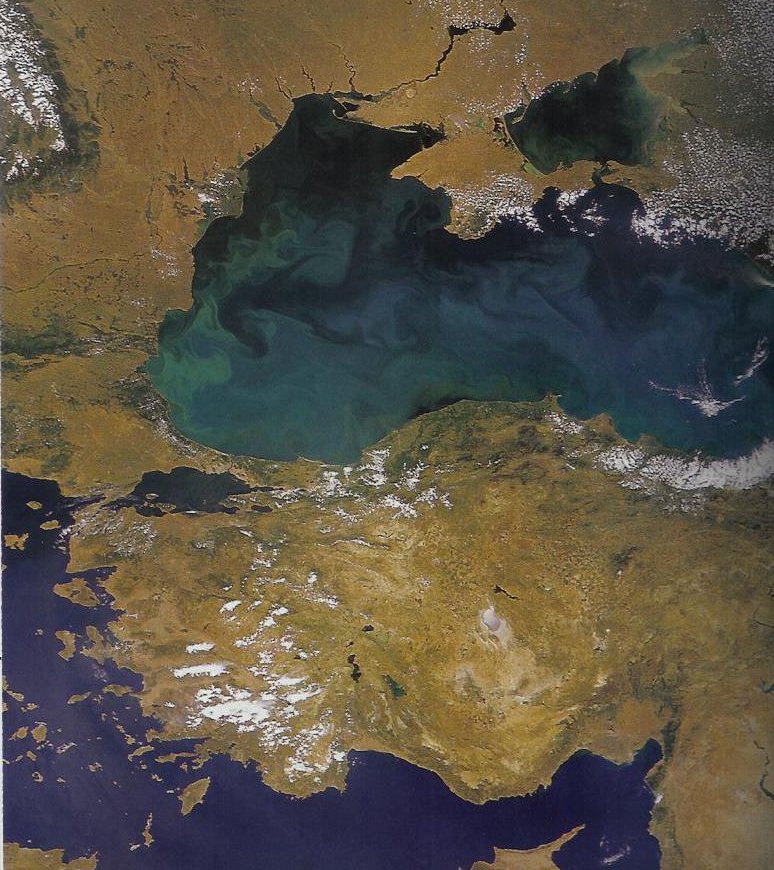
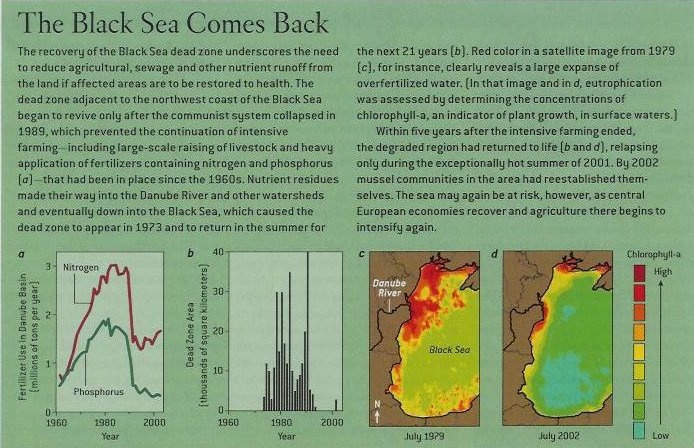
Click on the image to see it largerThe November 2006 issue of Scientific American has a fascinating article on "Reviving Dead Zones" which goes into the details of how the Black Sea was almost lost to heavy pollution but made a miraculous come back during the '90s.The culprit? Not anything you would suspect.Believe it or not, the culprits were the communist regimes that ruled Eastern Europe and to a certain extent, Ukraine. This is my summary of the amazing causality chain between the nature of a political regime and environmental pollution:1) The centralized communist regimes, as well as highly industrial European countries like Germany, heavily subsidized the use of fertilizers. They have also encouraged huge animal production facilities, like the 1-million head hog farm in Romania which produced as much sewage as a city of 5 million.2) The increased nitrogen content, phosphorus effluent and sewage washed off to the Black Sea mainly through the Danube River. 3) "As nutirent effluents [kept pouring into the Black Sea] dense phytoplankton blooms appeared in the surface waters [see the satellite photo above]."4) "Such luxuriant growth lowered water transparency..."5) "... which in turn deprived the bottom algae of light and eventually led to their loss, which altered the entire natural ecosystem [of the Black Sea]."6) Oxygen levels in the water started to fall, which led to...Click on the image to see it larger7) ... the death of mollusks en masse, which led bacteria and other organisms to consume the remaining local oxygen...8) ... which basically led to the slow suffocation of the Western Black Sea region [see the infra-red before-after satellite photos in the insert].So how did the recovery happen?"The area began to recover only when the communist regimes in eastern Europe fell at the end of 1989, ending central economic planning. Suddenly farmers there had little capital to buy fertilizer, so agricultural activities slowed. Likewise, many giant animal farms closed, thus profoundly reducing nutrient runoff... Within six years the profound drop-off in nutrient influx led to shrinkage of the dead zone."Read the whole article for a more detailed explanation of how Western Black Sea turned from the brink of extinction, thanks to the collapse of the centralized planned economies that fed junk into Danube.
<$Prof. Yayla triggers yet another Kemalism debate...
Prof. Atilla Yayla's speech related to Atatürk caused uproar and he was immediately fired from his teaching job. Sabah newspaper here provides who says what in the Kemalism debateinstigated by Prof. Yayla's speech... (the link is in Turkish...)
Prof. İsen also writes about the issue under the title: political adolescence...
Prof. Atilla Yayla's speech related to Atatürk caused uproar and he was immediately fired from his teaching job. Sabah newspaper here provides who says what in the Kemalism debateinstigated by Prof. Yayla's speech... (the link is in Turkish...)
Prof. İsen also writes about the issue under the title: political adolescence...
<$Papal visit (3) - A test for Turkey
Human rights in Turkey blog assesses the papal visit... Icarus Redeemed provides a more theological discussion
More than 25,000 people Muslims have taken part in a protest in Istanbul against the Pope's forthcoming visit to Turkey. Sunday's protest was organised by the Islamic Felicity Party, a small group that is not represented in the Turkish parliament....via
Mavi Boncuk provides the historical background: * The Latin Patriarch of Constantinople * Ecumenical Patriarch of Constantinople* 1,000-year Orthodox-Catholic rifts* Patriarch Bartholomeos I* 1967 Pope Paul VI and Ecumenical Patriarch Athenagoras
TIME Cover: The Passion of the PopeWith his blunt talk on Islam, Benedict XVI is altering the debate between the Muslim world and the West. On the eve of his visit to Turkey, TIME looks at the roots of the Pope's views--and how they may define his place in history
Human rights in Turkey blog assesses the papal visit... Icarus Redeemed provides a more theological discussion
More than 25,000 people Muslims have taken part in a protest in Istanbul against the Pope's forthcoming visit to Turkey. Sunday's protest was organised by the Islamic Felicity Party, a small group that is not represented in the Turkish parliament....via
Mavi Boncuk provides the historical background: * The Latin Patriarch of Constantinople * Ecumenical Patriarch of Constantinople* 1,000-year Orthodox-Catholic rifts* Patriarch Bartholomeos I* 1967 Pope Paul VI and Ecumenical Patriarch Athenagoras
TIME Cover: The Passion of the PopeWith his blunt talk on Islam, Benedict XVI is altering the debate between the Muslim world and the West. On the eve of his visit to Turkey, TIME looks at the roots of the Pope's views--and how they may define his place in history
<$Israeli writer Amos Oz' A Tale of Love and Darkness is a family saga as well as the document of a shattering tragedy. The legacy of the Holocaust reaches down the generations, with its sadness and fragmentation.
His mother lost everyone in her village, all of them rounded up and shot at the edge of the ditch which became their grave. His father lost his brother and his young family: father, wife and toddler shot together by the Germans.
Oz documents the birth of Israel as a modern nation. He works in the peace movement seeking some means of coexistence which recognizes both the demands of survival for the Jewish people and justice for those who lived on the land.
Oz wrote that as a child,
I hoped I would grow up to be a book....
Not a writer but a book. And that was from fear.
Because it was slowly dawning on those whose families had not arrived in Israel that the Germans had killed them all....
The air was heavy with dread. And I may have already gathered how easy it is to kill people.
Books are not difficult to burn either, it's true, but if I grew up to be a book, there was a good chance that at least one copy might manage to survive, if not here then in some other country, in some city, in some remote library, in a corner of some godforsaken bookcase.
I am always fascinated by the dedication to learning in so many Jewish families. Whether by reading Isaac Bashevis Singer or Chaim Potok, one sees what a heritage of study marked the tradition of the Jewish people. Sometimes the wives of rabbis would support the family, to allow the scholar to dedicate himself to his work. Oz wonders if the familiarity with finer thought outpaced the possibilities for his parents, and especially for his mother in her traditional role. A delicate soul, she was haunted by ghosts, an unhappy marriage and the pettiness she saw around her. She loved and forgave up to the point of her own great generosity, until illness and despair overtook her.
The story of the war of 1948 is a sober memory. People spent months in their cellars, holed up tightly with other families. For those who had just survived war, they had to endure a siege. A teenage boy, the only child of neighbors, was killed in front of his house. Another man was shot and they found him in the morgue, identified only by the socks which Oz' father had lent to him.
The author shows this difficult relationship with the other, the Arabs, in his memoir. As a young child, a kind Arab man came to his aid when he became separated from his babysitter. In a childhood accident initiated by Oz, an Arab child was injured, fainted and then was whisked away by his family. Inquiries on the part of his father about the child were rebuffed. Like a parable for the larger political situation, the impact made by one people on another can be largely hidden behind the curtain on the life of the other.
After his mother's death, Oz moved to a kibbutz. He spent thirty years there, finding that as much as he tried to leave the intense and insular life of learning behind in favor of the rugged simplicity of the farmer-settler, he found himself to be at heart a writer. At the point where he finds his own life is the subject of his art, he leaves off his personal history.
Oz shows a sympathy gathered up from the years to look back on a shadowed childhood and the struggles of a people driven back to the corner of the earth where they came from. The sufferings of the Jewish people are apocalyptic, and yet the need for justice among the clashing peoples is acute, as Oz acknowledges.
His mother lost everyone in her village, all of them rounded up and shot at the edge of the ditch which became their grave. His father lost his brother and his young family: father, wife and toddler shot together by the Germans.
Oz documents the birth of Israel as a modern nation. He works in the peace movement seeking some means of coexistence which recognizes both the demands of survival for the Jewish people and justice for those who lived on the land.
Oz wrote that as a child,
I hoped I would grow up to be a book....
Not a writer but a book. And that was from fear.
Because it was slowly dawning on those whose families had not arrived in Israel that the Germans had killed them all....
The air was heavy with dread. And I may have already gathered how easy it is to kill people.
Books are not difficult to burn either, it's true, but if I grew up to be a book, there was a good chance that at least one copy might manage to survive, if not here then in some other country, in some city, in some remote library, in a corner of some godforsaken bookcase.
I am always fascinated by the dedication to learning in so many Jewish families. Whether by reading Isaac Bashevis Singer or Chaim Potok, one sees what a heritage of study marked the tradition of the Jewish people. Sometimes the wives of rabbis would support the family, to allow the scholar to dedicate himself to his work. Oz wonders if the familiarity with finer thought outpaced the possibilities for his parents, and especially for his mother in her traditional role. A delicate soul, she was haunted by ghosts, an unhappy marriage and the pettiness she saw around her. She loved and forgave up to the point of her own great generosity, until illness and despair overtook her.
The story of the war of 1948 is a sober memory. People spent months in their cellars, holed up tightly with other families. For those who had just survived war, they had to endure a siege. A teenage boy, the only child of neighbors, was killed in front of his house. Another man was shot and they found him in the morgue, identified only by the socks which Oz' father had lent to him.
The author shows this difficult relationship with the other, the Arabs, in his memoir. As a young child, a kind Arab man came to his aid when he became separated from his babysitter. In a childhood accident initiated by Oz, an Arab child was injured, fainted and then was whisked away by his family. Inquiries on the part of his father about the child were rebuffed. Like a parable for the larger political situation, the impact made by one people on another can be largely hidden behind the curtain on the life of the other.
After his mother's death, Oz moved to a kibbutz. He spent thirty years there, finding that as much as he tried to leave the intense and insular life of learning behind in favor of the rugged simplicity of the farmer-settler, he found himself to be at heart a writer. At the point where he finds his own life is the subject of his art, he leaves off his personal history.
Oz shows a sympathy gathered up from the years to look back on a shadowed childhood and the struggles of a people driven back to the corner of the earth where they came from. The sufferings of the Jewish people are apocalyptic, and yet the need for justice among the clashing peoples is acute, as Oz acknowledges.